What is a neural network?
Nothing in it is a tiny brain. What it knows is stored as numbers, called weights, that were adjusted by training.
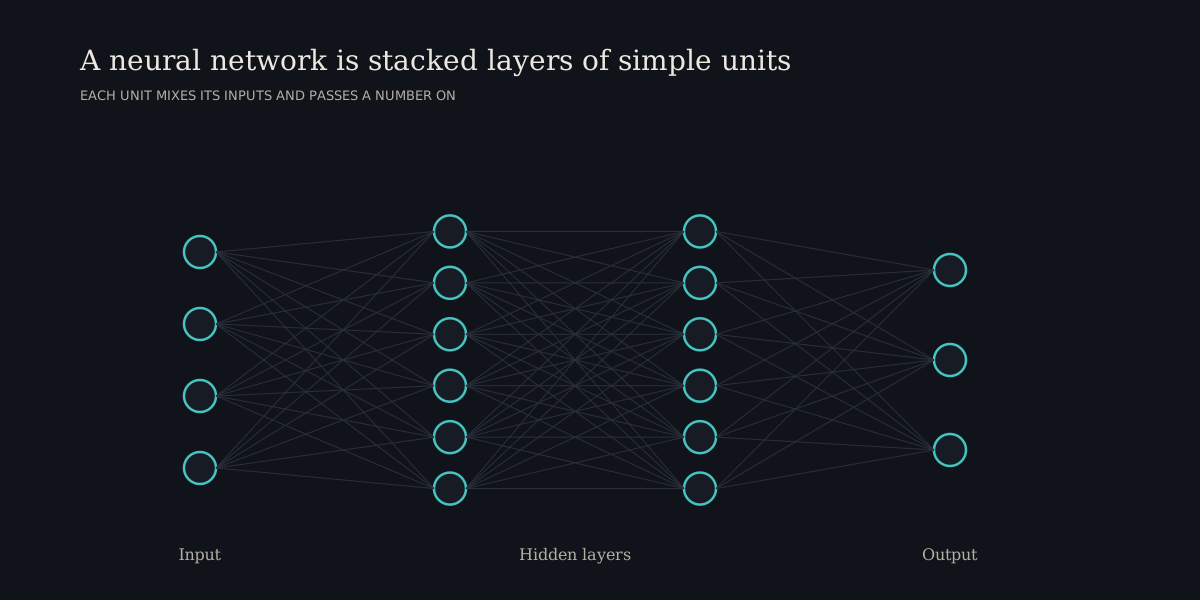
Simple units, stacked in layers
A neural network is a stack of very simple units. Each unit takes in some numbers, multiplies them by other numbers called weights, adds them up, and passes a result on, often after a small extra step that lets the stack represent curved relationships, not only straight lines. One unit is not interesting. Many units, in several layers, can represent surprisingly complicated maps from inputs to outputs.
The inputs might be the brightness of pixels, or numbers that stand for words, or a mix of both. The output might be a label, a next-word prediction, or a control signal. The shape of the network is chosen by people. The weights are not written by hand. They are found by training, which is the subject of Training versus inference.
What "learning" means here
The network is shown examples. For each example it produces an answer. A measure of error, often called a loss, says how far that answer was from the one you wanted. An algorithm then nudges the weights, a little at a time, so the error would have been smaller. After enough examples, the network may do well on cases it has not seen, as long as those cases are enough like the training data.
That last clause is doing a lot of work. A network that has seen many photographs of cats may label a new cat correctly. It may fail on a drawing, a night photo, or a kind of animal that was rare in the data. "It learned" does not mean "it understood the idea of a cat." It means the weights now implement a map that works on a certain slice of the world.
Why people say "neural," and why that can mislead
The name comes from a loose analogy to cells in a brain, which also take inputs and pass signals on. The analogy is historical, and it is easy to over-read. A modern network is a large numerical function. It does not have a life, a body, or a point of view. It does not think in the everyday sense, even when it produces fluent text. What these systems cannot do takes that limit seriously.
The useful part of the analogy is modest: lots of simple parts, combined, can do work that no one part was designed to do. The rest of the brain talk can wait. If you want to see the idea in pictures, the 3Blue1Brown lessons linked from our home page are a good next step. If you want to train something small yourself, the free courses from fast.ai and Hugging Face, also linked there, start with practice rather than with slogans.
Where this sits in the larger story
A network is a way to turn energy and data into a useful function. Training a large one takes a lot of both. That is why this site treats compute as an energy problem as well as a software problem, and why Type 2 Civilization and Kardashev II belong in the same network of sites. A civilization that wants more planning than people can do alone will run into a power bill. The bill is not a metaphor.
The same method, with different inputs, is what sits under language models and, when you add a loop and some tools, under agents. The network is the common part. The job you wrap around it is what changes.
Common questions
Is a neural network a model of a human brain?
No. It borrows a loose analogy and a name. The engineering object is a stack of numerical units with adjustable weights, not a simulation of a mind.
Do the units correspond to ideas or words?
Usually not in a clean way. A single unit is rarely "the cat detector." What the network has learned is spread across many weights. You can sometimes find directions in that space that line up with a useful idea, but that is a research result, not a guarantee.
Why do deeper networks get so much attention?
Stacking more layers, with enough data and compute, has turned out to be a powerful way to represent complicated maps. Depth is not magic on its own. A deeper network with too little data, or with a poorly chosen setup, can still fail.