Training versus inference
One is a long, expensive fitting process. The other is the everyday act of producing an answer. People often use one word, "running AI," for both.
Training builds the weights
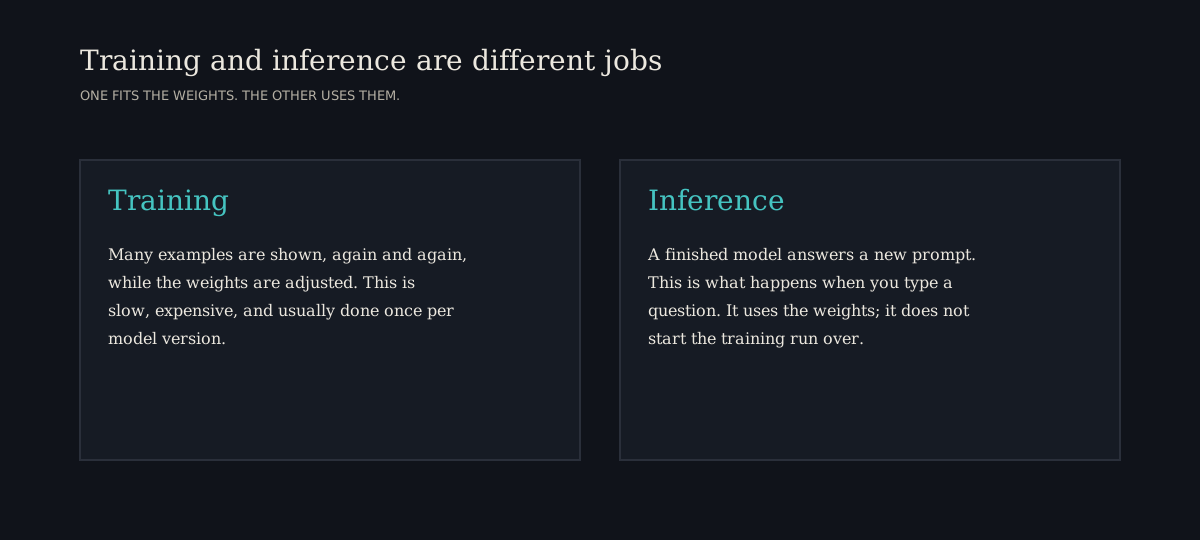
Training is the process described in What is a neural network?: show examples, measure error, nudge weights, repeat. For a large model this happens on many specialized chips, for a long time, using a lot of electricity and a lot of data. The result is a set of weights, a snapshot of what the model has fitted.
Training is not a single afternoon of work in the general case. It is closer to an industrial process. It can also happen in smaller doses later, when a model is fine-tuned on a narrower set of examples. Fine-tuning is still training. It is just training that starts from weights that already exist.
Inference uses the weights
Inference is the process of taking a new input, such as a prompt, and producing an output, such as the next tokens of an answer. The weights are usually held fixed during this step. You are not teaching the model a new profession each time you ask a question. You are running the function that training produced.
Inference is cheaper than training a large model from scratch, which is why many people can use a model that only a few organizations could afford to train. Cheaper is not free. A long answer, a large model, and a lot of users add up to a real power bill. The home page of this site already says that intelligence at scale is, in the end, an energy problem. Inference is one of the reasons.
Why the distinction matters
If you mix the two words, you will misread both cost and risk. A figure about the energy used to train a model does not tell you the energy used to answer one question. A figure about one question does not tell you the cost of a year of training. A safety issue that appears at training time, such as what was in the data, is not the same as a safety issue that appears at inference time, such as what the model just produced for a user.
The distinction also matters for the work you can do yourself. You can often run inference on a smaller model on a machine you already have, using the open tools linked from this site. Training a frontier-scale model is a different kind of project, and this page will not pretend otherwise.
Compute, energy, and the climb
Both training and inference turn electricity into heat and answers. As models and traffic grow, that load becomes part of the same energy story that Kardashev II tracks in other forms. This site will not invent a single worldwide figure for "the energy used by AI," because a number like that needs a scope and a source, and those change quickly. The honest claim is qualitative and still useful: the bill is large enough to matter, and it will not shrink just because the software feels weightless.
If the long-range picture is a civilization that plans and builds at a much larger scale, then compute is one of the loads that civilization will have to power. Type 2 Civilization is about that power. Robot Motion is about the machines that would act on the plans. This page is about not confusing the factory that makes a model with the act of using one.
Common questions
When I type a prompt, am I training the model?
Usually no. You are running inference: the existing weights are used to produce an answer. Some products may later use conversations to train a future model, but that is a separate policy, and it is not the same as updating the live weights with your single prompt.
Is fine-tuning the same as inference?
No. Fine-tuning is additional training on a narrower set of examples. Inference is using a trained model to produce an output.
Why do people say training is more expensive, if millions of people are using a model at once?
Training a large model is a concentrated, lengthy burst of compute. Inference is cheaper per question, but it can still add up when many questions are asked. Which one dominates a given year depends on the model, the traffic, and how often the model is retrained. There is no single ratio that covers every case.