What an AI agent is
The model is still a predictor. The agent wrapper is what lets it take steps, not only write an answer.
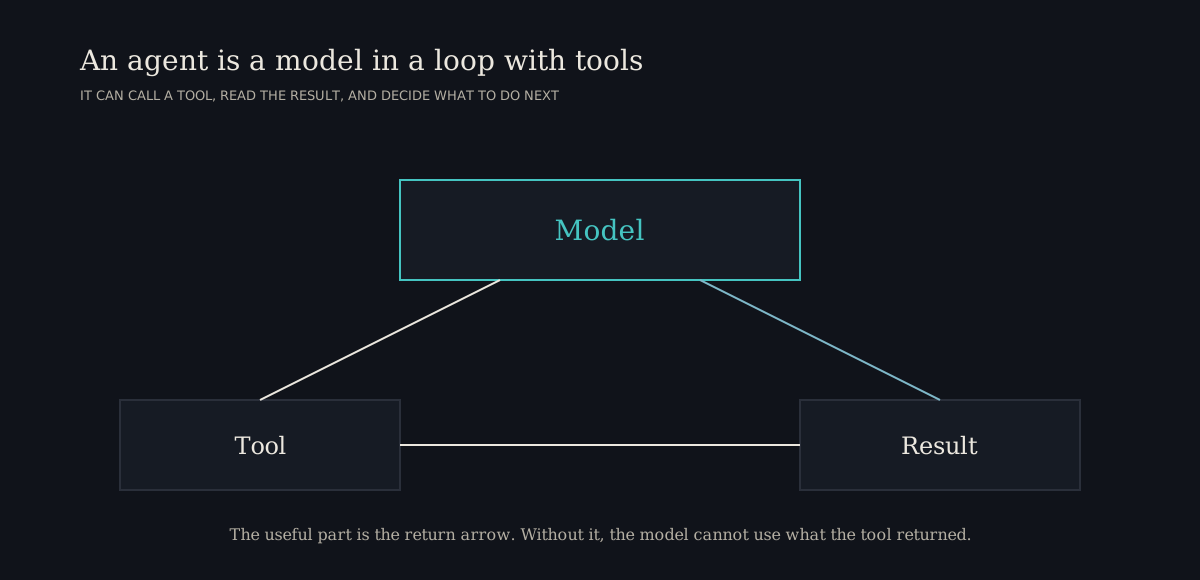
A loop, not a personality
In plain language, an agent is a model placed in a loop. You give it a goal and a set of tools, such as a code runner, a web search, or a file. It proposes a step, the tool runs, the result is added to the context, and the model proposes the next step. The loop continues until the goal looks done, or until a limit is hit: too many steps, too much cost, or a stop rule you wrote in advance.
The word "agent" can sound like a little employee. It is not. There is no inner person with a plan in the human sense. There is a model proposing the next action, and a program that is willing to execute some of those actions. If that sounds close to how language models predict text, it should. The agent is the model plus permission to act, plus a memory of what happened.
Why the loop is powerful
A single answer has to be right in one shot. A loop can check. It can run the code it just wrote and read the error. It can search again if the first source was thin. It can break a large job into smaller ones and keep a list. That is why agents are better than raw chat at tasks that have a natural "try, see, try again" shape, such as debugging a script or gathering a set of links.
The loop is also how an agent can be more dangerous than a chatbot that only talks. A tool that sends a message, changes a file, or spends money can do real harm if the next-step prediction is wrong. The power and the risk are the same design choice: the system is allowed to act.
Where the loop fails
Agents get stuck. They repeat a step that already failed. They misread a tool's output and wander. They satisfy a shallow version of the goal ("the file exists") instead of the goal you meant ("the file is correct"). They can also be verbose and costly, because each step is another inference pass, and a confused loop can run for a long time if you let it.
These failures are not mysterious if you keep the mechanism in view. The model is still predicting a plausible next action, not proving that the plan will work. A bad tool description, a messy work area, or a vague goal will produce a bad loop. Clear tools, tight permissions, and a stop condition are part of the design, not optional manners.
How this connects to machines that move
In software, the tools are often other programs. In the physical world, the tools are motors, grippers, and sensors. A robot that looks, moves, looks again is already a closed loop; Robot Motion describes that lower loop. An AI agent sitting on top of it would propose the coarser steps: go to the bench, pick up the part, check the fit.
That combination is easy to oversell. A language model that can write a plan is not the same as a robot that can carry the plan out. The agent still depends on honest sensing and on actuators that do what they are told. If you want the energy context for why this kind of planning is part of a larger climb, see Type 2 Civilization. If you want the limits of the model itself, see What these systems cannot do.
Common questions
Is a chatbot an agent?
Not by the definition used here, if all it does is return text. It becomes an agent when it is placed in a loop with tools and allowed to take steps toward a goal.
Does an agent remember everything it has done?
Only if the wrapping program stores that history and feeds it back in. The model has a limited context window. Long work needs an outside record, not just the chat transcript in a person's head.
Should an agent be allowed to use every tool it asks for?
No. Tools should be limited to what the job requires, and actions that cannot be undone should need a tighter check. The loop is only as safe as the permissions you give it.